Log 6 May 2014: Mile High Chemistry, Yost Lake 3 & Weekend 2

Though technically our class is over, I’ll continue posting about the events that happened in May, and I will probably do a couple each day, so that I can both resume spring semester posts, and start posting about my summer adventures as well.

So because of our failure of an expedition the previous Thursday, we ended up having to go back to Yost Lake to get a second set of water quality readings for the final watershed profile. While we were up there, we decided to get our lake depth reading and deep water sample, as well as our turbidity (water visibility) reading.

To do this, we decided to get up bright and early at 5:30. As usual, I got up a little earlier than my alarm, and found someone else still up from the night before, who had completely lost track of time and thought it was still 2 and not 5! The three of us were on the road by about 6:30. And I was paranoid about checking my Camelbak valve, to make sure it wasn’t pressed against anything!

When we got to the top, it was quite chilly, which made having to deal with the raft quite a miserable experience. Reid, who was the one who went in, discovered that the raft had two holes in it: one that let water into the seat, and one that was letting air out of the side. It became a race to finish.

We wrapped up everything by about 9:15, and made our way back down to the path. We made it to The Stove by 11 for a hot breakfast, which cheered everyone up I think. We made it back to SNARL just in time to see everyone else leaving for their adventure to go on a hike at Hot Creek (an exciting creek filled with geologic activity (geysers, hot pools, etc.). They invited us to go with them, since we were back. Our reaction? We got up at 5:30, just hiked 7 total miles up and back down 1,500 feet in elevation. Ha! (Thanks though).

I think we all crashed when we were back in the cabin, and were still like that when everyone returned an hour and a half later. A couple hours later, a small group of us went to the hot spring again, and surprisingly, we had the tub to ourselves (except for a few minutes when one woman joined us) and we able to enjoy our stay mostly undisturbed.

The rest of the weekend was pretty quiet, just working on homework until our meeting at 4pm on Sunday, to prepare for week 3!

Until Next Time,

Joe

Log 5 May 2014: Mile High Chemistry, Yost Lake 2

Ever hear of Murphy’s Law? I’m sure you have. Well, if there’s ever a time it applies, it would be now (though maybe not the literal definition of the law, more like the commonly used one).  We went back up to Yost Lake the Thursday of the second week. We had to get our stream flow measurements, our GLX unit readings and our soil samples, so we were contemplating spending the night up at Yost Lake.

Things started going bad almost immediately. To start us off, when we got to the trailhead, I discovered I was completely out of water in my Camelbak; the water valve had been pinched the whole ride over, and two liters of water spilled in the car. So now I was down to one liter for the 3.5-mile-up-1500-feet hike as well as staying overnight. By and by, we made it through the hike and got ready to conduct our sampling and measurements.

I offer to take the GLX readings and so head out to water sample site one, by the SW rocky shore. I’m going through the bag, and I discover that we have three of our four cartridges for the GLX unit. The one we’re missing? Naturally the water quality cartridge. So now there’s no need to worry about the GLX unit readings. I head over to Will and Reid to help them with the soil samples. Part of taking the soil samples is figuring out the slope of the sample location on the hillside. What naturally happens next? The tape measurer we have to help us calculate slope breaks. To solve that problem, we simply cut the tape measurer at about 13 feet to make sure we had plenty to work with. (Good thinking on our part, because we also needed this for the Stream Flow measure procedure).

While Reid went to work on the soil samples, Will and I then decided to go take the outflow stream flow measurement. There’s only one little problem… because of the drought, the outflow has dried up. Completely. So instead, the outflow seeps underground and continues that way. This is where we met up with Reid again, and we finished the soil samples together, on the East Side of the lake. Together we then went out to the inflow to measure the stream flow. It was a very narrow stream, so we bunched our data points together to try and get an adequate number of readings. The measurement involves putting a pvc pipe with a propeller on it in the water, and record (via electronic device) how many times it rotates in 60 seconds. In our practice session on SNARL’s campus, we were getting a reading of several hundred rotations. For Yost Lake, we got an overwhelming 7 times as the most rotations in any of the spots.

Once we got all our data, we decided to head back down. As a WFR, with critically low water levels, no stove to purify more water and enough time to get off the trail before it was totally dark, I made the call to go back instead of trying to risk dehydration and altitude sickness without water. It makes for a humorous story though.

Until Next Time,

Joe

Log 4 May 2014: Mile High Chemistry, Visiting Lecture Series

Currently in the middle of testing for Nitrogen on our Deep Water Sample (and re-doing our Outflow Sample, for consistency’s sake) and the first part of the lab is to “digest” our water sample and that requires a half-hour waiting time to sit and do nothing except watching a liquid bubble (and write blog posts!)

Last week, our Visiting Lecture was regarding Fire Ecology, using the Rim Fire that occurred in the Sierra Nevada in August of 2013. Quite different from the first talk, which was quite technical, this lecture was actually a lot of review (and some new stuff) for me. When I worked at Philmont in the News and Photo office last summer, I had several  news stories regarding fires and fire ecology at Philmont (Rocky Mountains in New Mexico).

The speaker talked a lot about high intensity fires, and one of the things he kept reiterating was that there is rarely a 100% mortality rate in even high intensity fires, and you can usually see the spots where trees (or parts of trees) are dead. His point of course was that fires are naturally occurring and necessary to stimulate forest plant growth. One surprising thing that he shared was that old growth forests are actually less likely to burn than recently burned forests that have started regenerating plant growth. The other surprising thing I remember him saying is that with global warming, there is no correlation (positive or negative) to increased high intensity fires.

The talk was quite a bit shorter, and a good deal more accessible to those community members (and us) who are not professional scientists or researchers. I personally wanted to ask him about Philmont’s Ponil Complex Fire from 2002 and ask why they are still having trouble getting regrowth to happen, whether it might be from human involvement (it actually slows down rather than speeds up natural fire regeneration) or if a fire can actually be so intense as to naturally sterilize large swatches of land.

Until Next Time,

Joe

Log 3 May 2014: Mile High Chemistry, Weekend 1

It’s been a while since I’ve been able to post. We’re kept rather busy here for the most part: school days are filled with class from morning to late afternoon, immediately after which is recovery time (after almost 6 hours of class) and then dinner, and then do reading for the next day. Monday through Friday. But then comes the weekend. And what good would it be to sit around and do nothing while there’s so much to explore in this area that we can’t possibly do all of in three weekends? Consequently, weekends end up being (if possible) even busier.

For our first weekend (May 10-11), I joined the group of people who rock climbed on Saturday. This was a most of the day event, leaving at 10am and returning around 3pm. I actually climbed more than I thought  I was going to. The first climb we started with, was a 5.5 and I practically just walked up that thing. It made me feel good, but in terms of a challenge, it was disappointing. As it turns out however, we were not the only ones who were in the area. There was an AMGA (I believe) instructor certification course going on. They were kind enough to let us use a couple of their unused ropes. Some people went up the 5.6 and when they needed to use that, we went over to the 5.7 course, which is what I set out to do.

Naturally, me, by nature of being me, did not simply go up the logical and straightforward path. I ended up veering off to the right, and inadvertently ended up climbing a 5.10 climb. I had no idea at the time. And it was a tall climb too, going up over 100, by Rebecca Lyons’ estimation. But that was the challenge that I was looking for. Interestingly enough though, it never seemed to me (in the moment) anything that was too tough. Sure, there were times I considered yelling “Take” to come back down, but every time I thought that, I looked at the rock, and could see the necessary placements for my feet (or perhaps where my hands needed to reach to) and knew that I just needed to make it happen. That was the only choice.

Both climbs I didn’t want to be distracted my North Face jacket getting in the way, so I took it off. I was already in shorts anyway, and it was quite gusty (and cold) that day. Hence, I got dubbed with “ice water in my veins.” I was asked if I was from Maine, and I said, nope, just Chicago. J

After the exciting day of climbing however, and watching others push their boundaries with fear (of heights) a little further, we drove back to SNARL and some of us got ready to visit a local hot spring. We soaked for an hour, had a conversation with two interesting men, and felt greatly replenished on the drive back.

On Sunday, most groups went up to their lakes, so Will, Reid and I decided to go on a short hike down Hot Creek. It’s about an hour long hike, and greatly resembles Yellowstone with scalding hot pools here and there.  It was quite beautiful and a bit warm (quite different from when we first arrived at SNARL). Afterwards we went into town for a hearty lunch (difficult to find, almost everywhere likes to close early and on weekends) and then made our way back to our weekly meeting (and the conclusion of our weekend).

Until Next Time,

Joe

Joe Rock Climbing

Log 2 May 2014: Mile High Chemistry, Yost Lake

IMG_1844

Yesterday, we had our first lab in the field. Our team broke up into groups (4 groups of 3, more or less), to go conduct the research that we have been learning about so far this week. The data we have covered so far includes the Air Temp, Water Temp, Wind speed, Wind direction, Barometric Pressure, Relative Humidity, Water Conductivity, Water pH, Dissolved Oxygen (D.O.) in the water and Stream Flow. We managed to get almost all of that except the Stream Flow (mostly because we only have one set of equipment so we all need to take turns).

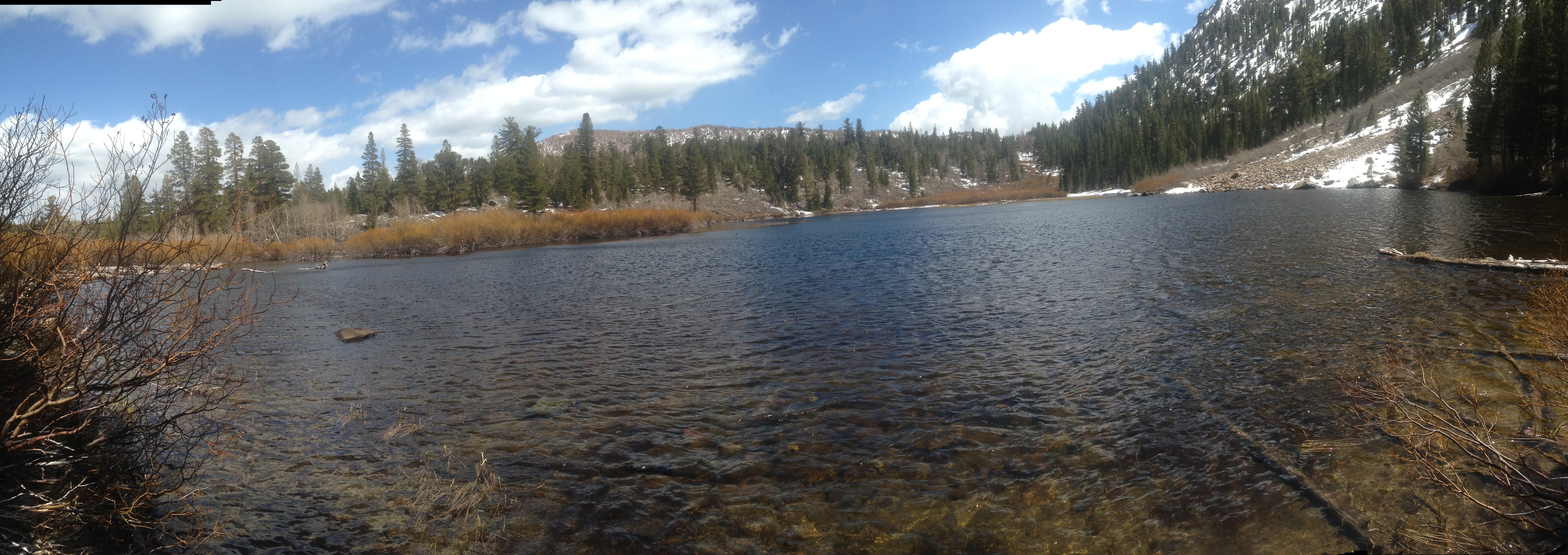
Yost Lake is relatively excluded and is hidden behind a rather rigorous hike. The hike is not extreme, it’s about 3 miles and 1,000 feet up, but be prepared for an hour of intense uphill. The second half  (probably about the last third) is way more relaxed, and almost flat all the way to the lake. Yost Lake is stunningly beautiful, as are most of the High Sierras. It’s got a rocky shore to the south, and marsh plants to the East, North, and part of the West. Along the west shore however is a pleasant path between towering pines that gets you right to the rock shore.

4 of us went up to the lake, Will, Reid, Erin (our T.A.) and myself. I enjoyed the time spent immensely, and look forward to going back next week, most likely to spend the night. It’s still quite cold up there, and there is plenty of snow to find as well. It made hiking difficult at times, but we all made it up to the top with smiles. The photo linked with this post is of Yost Lake from the path along the western side.

Until Next Time,

Joe

Log 1 May 2014: Mile High Chemistry, Visiting Lecture Series

This is my first post in regards to my May Term. A year ago, I was in Europe, backpacking for a month. Now, I am in the Eastern Sierras doing chemistry research, living with 10 other incredibly bright Proudian Honors Students.

This first post is about the lecture we listened to last night. It was very technical so I don’t have too much to say, but it was interesting. The speaker was from the Airborne Snow Observatory based in California. His presentation was (as far as I could tell) regarding the methodology of how they research snowfall in southern California, primarily determining the quantity of snowfall to help with runoff models (to study how watersheds are effected). Beyond that, it mostly flew over my head.

Every Tuesday night, SNARL (Sierra Nevada Aquatic Research Laboratory) hosts a guest speaker for part of their Visiting Lecture Series during the spring season.

Until Next Time,

Joe

Visiting Writer’s Series: Spring 2014 ~ Ralph Angel

Taking place towards the end of March, the VWS featured one of Redlands’ own, which puts into question the fairness of “visiting” in VWS. The reason this event was so interesting was because I took Poetry Workshop II with Ralph this semester, so I got to listen to my professor speak at a professional, community open event.

A lot of what he talked about he had brought up in our first class of the semester. He holds an inspiring reverence for art in all its forms. One of his “famous” quotes is that he has 10,000 gods that he worships. Each one is an artist or inspiring person of some sort. He has painters, writers, film makers, etc. in his collection of gods, among others. Interestingly some of the poems that he writes are homages to those artists.

The other thing that he likes to talk about is how powerful language is. One of the things he would tell us in class constantly is that we should let the language do all the work in our poems, rather than us trying to do the work, because language is so much more powerful than we can hope to be. Language has been around long before us, he says, and it will be around a lot longer than us, he also says. In other words, it will outlive him, in his own words.

Just by listening to him speak, you get a strong sense of how seriously he takes his work. His art.

Until Next Time,

Joe


Visiting Writer’s Series: Spring 2014 ~ David Treuer

This was an all-day event February 13, 2014. We had our typical 3 hour fiction workshop from 1-4 and then at 4:30 we had (as a class) a private Q&A session with him. His stories were quite interesting: he did not grow up thinking he was going to be a writer. he did not go to school knowing that he loved to write and that that was what he wanted to do with his life. But when he got to Princeton University, he ended up applying to the writing program.

In that time, he had developed a rivalry with another writer who told him that he would never get into the program. Indeed, that year he was not accepted into the creative writing program. The second year he applied he got in, and then consequently studied with Toni Morrison as his creative writing advisor.

Another amusing story he shared regarded his first novel, which we read an excerpt of in class. We asked if he loved his novel when it was published. He said absolutely, and added that he thought it would get him to be rich and famous. Of course, now he looks down on that writing and certainly that kind of thinking. Nowadays, he is not nearly so fond of his first novel, and enjoys his non-fiction book, much more.

Later that night at his reading, it was done in a different way than I have usually seen a reading. As he read the excerpt he had selected (from his memoir Rez Life)he kept interrupting himself to share the backstory of the scene he was reading, or a memory the scene triggered, or at least some tangentially relevant story. It was highly entertaining and it seemed to give me more of a reason to show up to the reading, rather than just going to listen to something I could just read later. Probably my favorite VWS event I’ve attended so far.

Until Next Time,

Joe


The Truth of the Matter (Part 1)

Truth is a funny thing on Earth. In a world that is more scientifically driven than ever before, we’re constantly trying to measure and categorize this world and our experience on it. However, I do believe that anyone can make art out of anything, even if it does involve numbers and math. And I will not stray from that belief.

I do have my criticism of numbers and statists however. Writers are constantly battling the question “why bother writing stories about the world when statistics can tell me everything I need to know?” Take the Holocaust for example. Some would point to the approximately six million Jews that were murdered and ask, “Why do I need to know any more to understand the terrible destruction of the Holocaust?” A valid point. That statistic, and many others, do give a very comprehensive big picture of the massacre. But it fails to do justice, I think, of the six million individuals who sacrificed their lives.

But statistics don’t about individuals, some would say. I know. Because numbers can only do so much. That’s where stories come in. Stories, if told properly, have the power to move hearts and make a real impact. Stories capture a meaning that numbers do not. Take the Holocaust again. Yes, one can talk about the six million Jews that were murdered. But what about the boy who grows up with his Christian friend, they do everything together, but the Jewish boy watches his family fall apart and die: first his mother, then his father; he tries to make it on his own after that until an air strike comes, and his anti-Semitic landlord keeps him out of the bomb shelter, resulting in his death, and his body being taken out with the morning trash.

Which has more of an impact?

But the examination doesn’t end there. The story I reference is a fictional novel written in German. It could just as easily have been a memoir. What if it had been advertised as a memoir? There’d probably be riots and protests and recalls of the book. And that’s after the slew of law suits directed toward the author.

The public these days is super touchy about getting what they were advertised. If something is advertised as a memoir, then it better be pretty damn true. There are numerous examples of false memoirs revealed, and the catastrophic results that ensue. At the same time, a memoir advertised as a novel can get a writer into equally serious trouble, but personally and socially (not legally). So is it possible to draw this line of truth? Stories tell the truth of individuals… the more resonant they are within us, the more beautiful they are. But then stories (narratives specifically – foregoing poetry and play/screen writes for now) have several options to relay that Truth: telling the truth or not.

And what’s the difference? Why does the difference matter? I have seen authors put disclaimers into their (fictional) books stating that like any other book, his story draws a lot upon personal experience, but is in no way a memoir or even a reflection of actual events.

Why? And if so many authors combine reality and fiction, then why do we distinguish two different genres? How do we do it? As for the why… marketing. There’s a lot of money to be made selling someone’s “true” story. If truth were combined with fiction into only one genre, there’d be a lot less money (and way more competition) than selling more books, given there are more available categories to be selling books in. It would seem then, that these different genres of writing are based in part on marketing. This begs the question then, are the different genres natural to art/writing or socially constructed? For example, is there an “inherent poetry” or does poetry exist because advertisers say it does? To be continued…

Until next time,

Joe

A Rose by any other Name is not as sweet

A Rose by any other Name

Humans have long been obsessed with language and communication. Our Non-fiction workshop spent the first few weeks discussing how the beginning of human consciousness found meaning, which you can read more about in my blog post, “Writing as Expression”. But the question that I want to delve into is now that humans have developed language (not just orally but as symbols), is our use of language – from selecting words to weaving complex stories – just words? Or is there something more that underlies it. And what places do names hold in this? Are they more or less special than other words? Or are they even different?

My case study to examine language is Christopher Paolini’s Inheritance Cycle. In this fantasy world, there is a magic language known to elves, dragon riders, and demonic creatures and humans. Within this language lies the true word for physical or verbal representatives. For example, let’s take water. Water you pour into a glass is the physical (object) representative. If you use water’s name in the magic language, you draw up its essence. Not the stuff you drink or pour, but the mystical property that is the pure essence of water. The same thing can be done for metals, rocks and even man made items such as a sword.

To continue to my point however, the rules to this world and language suggest there is great intentionality in the choice of words, and a powerful meaning behind each one. My example is at the end of the series.

SPOILER ALERT

The evil king, King Galbatorix, through decades of research and hell-bent determination, learned the magic name of the ancient, magic language, giving him control of all of magic and therefore the world.

END SPOILER ALERT

This example suggests that power lies not just in the power of words, but in the power of names. This is a central ploy throughout the series, with characters hiding their name as it is in the magic language, because whoever knows it has access to that individual’s essence, and as such, has the power to control them.

To bring this back to the real world, the discussion of names and their lack of importance came up in our Non-fiction I workshop. We discussed how words, and so names, are simply arbitrary. Why does water mean the liquid which all life needs to sustain life? What truly binds that concept to the word water? It would seem just the fact that everyone uses that word to mean as such, and so now there’s an expectation that everyone learns that water is this life sustaining liquid.

But… what if, at the beginning of language development, someone picked the word fire to mean this life-sustaining liquid? And then that go passed down through the eons, just as water has? What would make “fire” different than “water” today? Nothing.

So then are words just arbitrary, if their assigned meanings are just random, and could be switched if enough people went along? While that might work, ONLY if enough people went along with it, I don’t think so.

I’m going to delve into poetry a bit here, and argue the words we use are important to the greater picture. Words are the building blocks to sentences, sentences to paragraphs, and paragraphs to narratives. In the architecture of these great structures (narratives), I believe it is crucial to carefully place each and every piece to the foundation (words). How the word sounds, how it feels, how it looks should all be considered.

I like to make a couple music references here, when I think of precision word usage, and that is to Stravinsky’s Firebird Suite, and Michael Torke’s Bright Blue Music. If you listen to either, it sounds like a nest of notes, all jumbled together in a chaotic and messy way (especially Firebird Suite). However, if you listen to it proactively (or, especially perform it as I have done) you begin to get a sense for the precise choices Stravinsky made. Not a sixteenth rest is out of place. The same can be said for Bright Blue Music. It is my belief that if a narrative is carefully constructed and solidly built at the word and sentence level, then it will help the bigger picture (the story) be more successful and well crafted (though I should mention care also needs to be given to the storyline – nothing excuses a poorly delivered plot).

To go back to names however, in our workshop discussion, we wondered whether names have an impact on the story, specifically in the context of your own (if it’s a memoir style of writing). Our professor noted that he never used his name in his published writing. This discussion came up because it was notable that a girl in our class used her own name in her story.

If names are really this notable, then contrary to our discussion, I would argue there is great significance to names. If using a name changes the tone to a story, then it does matter. I argued that for many people, our sense of identity revolves greatly around our names. And I think Paolini would agree, since the way to control a creature in his world, is to know its true name.

Until next time,

Joe