Art or Insanity? Seeing the Unreal

How often do we hear that artists are insane, or they’re crazy people who make unbelievable things? That their best work is when they’re under the influence of hard drugs? Or that one can never be successful trying to live as an artist, and they have to be crazy to try?

At least as an artist, I hear them pretty often. In Non-Fiction Workshop I, we were talking about how artistic personas and insanity go hand in hand, because it seems there is a very fine line between the two. My first thought is to refer to the imagination. It is my belief that writers (and artists in general) tend to have very vivid, constantly running imaginations. We have to, because the basis of our work is making the unreal, real. And imagination is the vision that sees anything and everything unreal.

So, then, one could argue that artists are people with a sixth sense. We have a knack for sensing what is there, which doesn’t exist yet, catching it, and then obsessing over it and working with it (with hands for the sculptor, pen/paper or keyboard/fingers for writers). But does any of this make an artist a crazy person? Sure sounds like it.

There are three considerations I’d like to discuss. First, if you’re an artist, and you pursue it as any kind of career, you’re automatically insane on some level, because the odds of you actually succeeding are so slim, you have to be crazy to go up against them.

In our workshop, the discussion took a different turn. We were talking about different types of artists: those who are actually crazy, and those who pretend to be crazy under the guise of being an artist. I find it remarkable that our society has put art on such a pedestal that if you are an artist, even a self-proclaimed one, you’re given a free pass on being as crazy as you like. In fact, it’s more or less expected of you. And if you don’t/aren’t identified as an artist, you’re locked away because you’re a “menace to the public”.

A third avenue to consider also is the distinction between being crazy and being reckless. Think of your favorite artist or band. Many of us would say “oh man, his music was so good when he was addicted to drugs… now he’s just ok.” I’ve heard this claim more than once and about more than one artist. It would suggest that the more reckless an artist is with him or herself (and therefore the sixth sense/creative spirit) the more enjoyable the product is.

So which is it? Are all artists insane? Are only some insane while others pretend to be? Are artists who are more reckless with their insanity more successful? I’m not going to pretend to know the answer, but I will put in my two cents.

I believe in strongly that each artist is his own or her own visionary. I began this blog post with a discussion of the artist’s role to make the unreal, real. Each artist has a vision in his or her mind, a vision that is impossibly bright and powerful – a star to strive for. This is why I am convinced anyone can be an artist, not just a painter or sculptor, a musician or writer. An artist is simply someone who not only has a vision, but has the nerve, gut and passion to make it a reality. That’s why, to me, a business man can be an artist. If he sees potential and, with some devotion and passion, strives for it, he’s as much an artist as the painter down the road, struggling to keep his shop open.

My example is Steve Jobs. Take a look at the precedence he set. He started making and selling computers out of his garage. A hobby. And he single-handedly changed (or at least made a lasting impact on) the music-entertainment industry, and how it reaches the hands to the general public. He took his passion for digital technology, and made it an art, stretching far beyond just the small scope of a backyard business. Was he insane? I say no. To me, insanity is in the eye of the beholder, and the artist is only as insane as their vision, and their dedication to that vision, is to you.

Until next time,

Joe

Artist word count: 25
Public Sociology

We always seem to hear what “the sociologists” are doing or saying, how they’re analyzing the latest “new fad” or trying to tackle age old problems and find a solution once and for all. The difficulties with sociology is that it’s about… well… humans. And humans, as we know, are variable creatures that have hundreds, if not thousands, of influences and factors that dictate how they behave. And of course, psychology shouldn’t be overlooked either, as it does give insight to how individual humans tick. But that’s not what I’m here to talk about today.

Today I’m here to discuss public sociology, what it is, and how our intro sociology class made a small-scale attempt at replicating this subject. To start off, if sociology is more or less the study of how humans are influenced by human-formed groups (race, gender, social class, media, family, religion, medicine, sports, government, economy… I could go on and on) then public sociology must be the study of this in the context of the public sphere. So what does that look like in specific terms, rather than abstract ones? Well, I can hardly imagine a better example than one that is dividing the nation right now: same-sex marriage and same-sex parenting.

I should be quick to note that just because an issue is talked about nationally, does NOT make it inherently public sociology. So just because same-sex marriage is a contentious issue presently, does not make it public sociology. Public sociology is not assigned to various topics (some get it and some don’t) it’s applied more specifically to the type of research and the intent of that research of any given societal issue. I point to same-sex parenting specifically, because there is a lot of interest currently as to the scientific findings of whether or not same-sex couples can be as reliable and successful as parents that heterosexual couples can be. Some of this research is being conducted specifically to forward the activist cause of equal rights/gay pride. It is the fact that this research is not just being written for academia to be put into a dusty volume and forgotten about, but thrust into the public sphere to attempt to influence public opinion.

So, the question is then, what does our class have to do with this? Well, for the month of November, we broke up into groups and each group conducted a project, with the intent of it being a public sociology project. My group created a magazine that covered the issue of gender. We attempted to convey the tone of such a magazine as realistically as possible, including components such as the Letter from the Editors addressing the selection of this specific topic: gender. Now that the magazine has been put together, it is time to share it, and make it from an academia project to a public one.

Sociology 101

Until Next Time,

Joe

Writing as Expression

Hey there!

It’s been a while since I’ve posted, I know. Things get busy and catch you by surprise. I’m writing today to reflect on the past several weeks of my Non-fiction Workshop I course.

I will admit the beginning of the class startled me. We started the class in silence (our professor didn’t say a word to us) and had us listen to “The Unanswered Question” by Charles Ives, an eerie and serene song representing humans asking what the meaning of life is. And so creative non-fiction began.

The discussion led to where creation, a primal instinct of mankind, comes from. It led us to the Lascaux caves, and a discussion on art and creation as old as 50,000 years. We, as a species, have always been driven to create since (essentially) our conscious existence. From a modern day perspective, I would like to think that art is perhaps one of the most beneficial mediums when considering human happiness. Thinking back to my Senior Writers’ Seminar in high school, we talked about art supplying meaning to human lives.

I think that remains true today. Clearly, telling stories and communicating with others has always been an instinct of mankind. Why else would a primitive species, in the infancy of its development, be driven to inspire such awesome paintings with such minimal supplies? Why else would the communication aspects of our brains develop in such intricate and complicated ways unparalleled by every other known creature?

And where does it come from, this urge? Especially as writers (modern day storytellers), the one art craft that has nothing but its own imagination to rely on as tools of the trade. Why do we chose – why are we compelled – to delve into the depths of our own psyches and dredge up the muck and sorrow and pain that lies within human conflict, the source of storytelling?
Because it gives us meaning. It gives us a way to look at our own lives and ask ourselves the most basic and essential questions about how we live. What do I want to achieve? Have I lived the way I wanted? What regrets do I have? How might I live without regrets? In my senior seminar, we discussed that fiction can have more Truth – with a capital T – than facts about the world. Throw all the statistics at me – give me your fail rates, acceptance rates, birth rates, death rates – but with my one story, I can touch your heart more profoundly than you could ever hope to touch mine.

When we first started this class, I thought it was way off base from the other creative non-fiction class I had taken. Then I realized they were right in sync. Both examined art and why we (artists) do what we do. Both took into consideration the need to create and though one took a contemporary paintings view and the other stretching back to the infinite chaos from which creation was birthed, both had the same idea: thinking about the greater purpose of creation, not for the global world, but for ourselves.

Until next time,

Joe

Equality Moves Forward: Part Two (Prop. 8)

In the second of two landmark cases on same-sex marriage, the US Supreme Court gave same-sex marriage supporters a second large victory, but this time by choosing not to rule on the case in front of them.

            In this case, Chief Justice John Roberts wrote the Opinion of the Court, which was a 5-4 majority, although surprisingly, this time the divide was not by party lines. He starts off by identifying what it is the Court was asked to rule on. “In this case, petitioners, who oppose same-sex marriage, ask us to decide whether the Equal Protection Clause “prohibits the State of California from defining marriage as the union of a man and a woman.” Respondents, same-sex couples who wish to marry, view the issue in somewhat different terms: For them, it is whether California—having previously recognized the right of same-sex couples to marry—may reverse that decision through a referendum.

            Roberts says next, “Federal courts have authority under the Constitution to answer such questions only if necessary to do so in the course of deciding an actual “case” or “controversy.” As used in the Constitution, those words do not include every sort of dispute, but only those “historically viewed as capable of resolution through the judicial process.” This is the central argument to the Opinion of the Court. Roberts even makes a point of identifying the importance of this to the Supreme Court.

            “This is an essential limit on our power: It ensures that we act as judges, and do not engage in policymaking properly left to elected representatives. For there to be such a case or controversy, it is not enough that the party invoking the power of the court have a keen interest in the issue. That party must also have “standing,” which requires, among other things, that it have suffered a concrete and particularized injury. Because we find that petitioners do not have standing, we have no authority to decide this case on the merits, and neither did the Ninth Circuit.

            The last sentence is a short summary of the ruling of the court, but to Roberts, this point that the Court must be faced with an “actual case” or “controversy,” is one of the key checks on the Supreme Court. To him, this is the defining difference between the Supreme Court and Congress, the “elected representatives” whose job is to “engage in policymaking.”

            Roberts addresses the role of standing in court cases. He says, “Most standing cases consider whether a plaintiff has satisfied the requirement when filing suit, but Article III demands that an “actual controversy” persist throughout all stages of litigation.” It is that last part, “persist throughout all stages of litigation,” that is key to the Court’s decision.

            At first, Roberts addresses the Court’s skepticism of the petitioners (the people choosing to fight to maintain the legality of Prop. 8 in place of the state government) standing to defend the case. “The only individuals who sought to appeal that order were petitioners, who had intervened in the District Court. But the District Court had not ordered them to do or refrain from doing anything. To have standing, a litigant must seek relief for an injury that affects him in a “personal and individual way.” He must possess a “direct stake in the outcome” of the case. Here, however, petitioners had no “direct stake” in the outcome of their appeal. Their only interest in having the District Court order reversed was to vindicate the constitutional validity of a generally applicable California law. We have repeatedly held that such a “generalized grievance,” no matter how sincere, is insufficient to confer standing.

            To have standing in Court, one must seek relief for an “injury that affects him in a ‘personal and individual way.’” The Respondents, as Roberts has dubbed the two couples fighting Prop. 8, had standing, because they were seeking relief from a specific injury: a referendum that denied them marriage after the State legalized it. The petitioners however, according to Roberts, had no “direct stake” in the ruling given to their appeal. They were merely interested in upholding “a generally applicable California law” (general here meaning affecting many people no more specifically than themselves). According to Roberts, the Court has repeatedly ruled that a grievance this generalized is insufficient for standing in Court.

Roberts goes on to address the counter argument the Petitioners gave about California’s Constitution and election laws. “Petitioners argue that the California Constitution and its election laws give them a “‘unique,’ ‘special,’ and ‘distinct’ role in the initiative process—one ‘involving both authority and responsibilities that differ from other supporters of the measure.’” True enough—but only when it comes to the process of enacting the law. Upon submitting the proposed initiative to the attorney general, petitioners became the official “proponents” of Proposition 8. As such, they were responsible for collecting the signatures required to qualify the measure for the ballot. After those signatures were collected, the proponents alone had the right to file the measure with election officials to put it on the ballot. Petitioners also possessed control over the arguments in favor of the initiative that would appear in California’s ballot pamphlets. But once Proposition 8 was approved by the voters, the measure became “a duly enacted constitutional amendment or statute.” Petitioners have no role—special or otherwise—in the enforcement of Proposition 8.

            Here, Roberts admits that the Petitioners held the rights to the initiative up to the point it went on the ballot. They became responsible for collecting signatures, and to follow through and submit it to the election officials for the vote. They also had control over the information that would show up on the ballot pamphlets. He draws the line at the vote however. His argument is that once Proposition 8 was approved by the voters, it became a government issue. Essentially Roberts is saying the petitioners have no legal authority to enforce Proposition 8. As they have no control over the enforcement of the law, they are no different from other citizens not fighting to keep Prop. 8.

            “They therefore have no “personal stake” in defending its enforcement that is distinguishable from the general interest of every citizen of California. Article III standing ‘is not to be placed in the hands of ‘concerned bystanders,’ who will use it simply as a ‘vehicle for the vindication of value interests.’’”

            Essentially Roberts is telling the petitioners that the Court will not grant Article III standing to citizens who only have a general interest in upholding a law. As they are not seeking relief to an injury, and have no legal jurisdiction in enforcing the law, the Court sees they have no standing, giving the Supreme Court no authority to hear the case. The final Supreme Court decision is as follows:

“We have never before upheld the standing of a private party to defend the constitutionality of a state statute when state officials have chosen not to. We decline to do so for the first time here. Because petitioners have not satisfied their burden to demonstrate standing to appeal the judgment of the District Court, the Ninth Circuit was without jurisdiction to consider the appeal. The judgment of the Ninth Circuit is vacated, and the case is remanded with instructions to dismiss the appeal for lack of jurisdiction.”

            The Supreme Court took it one step further and struck down the Ninth Circuit’s decision, saying the petitioners also lacked standing in that case, and so the Ninth Circuit had no authority to consider the appeal. As the District Court did have legal authority to hear the case, the decision of the District Court, which ruled Proposition 8 unconstitutional, stands.

            What does this mean? Well, the federal Court, which put a freeze on all same-sex marriages in California until the Supreme Court issued its ruling, removed that freeze a couple days later. Within days of that announcement, same-sex marriages resumed in California, making it the 13th state in the United States to legalize same-sex marriages, now including federal benefits due to the Supreme Court’s ruling on DOMA.

Equality Moves Forward: Part One (DOMA)

*I know it’s not writing or camping, but it is something so significant, that I feel it deserves noteworthy attention, and examination to try and understand what exactly the rulings are and what they mean.*

It is June 26, 2013. Today the Supreme Court of the United States of America ruled on two cases regarding same-sex marriages. I will examine both of them in turn, starting with the Court’s decision to strike down DOMA.

*A quick note: Everything I quote is from the Opinion of the Court, written by Associate Justice Anthony Kennedy.*

First I want to just put down the actual ruling, as written by Kennedy, to be as clear as possible what it is that the court actually decided today. “What has been explained to this point should more than suffice to establish that the principal purpose and the necessary effect of this law are to demean those persons who are in a lawful same-sex marriage. This requires the Court to hold, as it now does, that DOMA is unconstitutional as a deprivation of the liberty of the person protected by the Fifth Amendment of the Constitution.”

I shall mention, though not bother to cover in great detail, that the first part of the ruling covers the Court’s consideration of the validity of the case. Looking at the case as “unusual,” it was decided by the majority that the Court had the authority to consider the issue.

There are two primary aspects the majority focused on in their arguments for striking down Section 3 of DOMA and those are considering the intent of DOMA and state powers against federal powers.

To start off, Kennedy notes what DOMA does and does not do. “The definitional provision does not by its terms forbid States from enacting laws permitting same-sex marriages or civil unions or providing state benefits to residents in that status. The enactment’s comprehensive definition of marriage for purposes of all federal statutes and other regulations or directives covered by its terms, however, does control over 1,000 federal laws in which marital or spousal status is addressed as a matter of federal law.”

Essentially he is saying here that DOMA does not state the performance of same-sex marriages is illegal. It states that the over 1,000 federal benefits or “laws in which marital or spousal status is addressed as a matter of federal law” are directed towards the Act’s definition of marriage, which is “In determining the meaning of any Act of Congress, or of any ruling, regulation, or interpretation of the various administrative bureaus and agencies of the United States, the word ‘marriage’ means only a legal union between one man and one woman as husband and wife, and the word ‘spouse’ refers only to a person of the opposite sex who is a husband or a wife.” In short, the act denies the federal benefits to same-sex couples because federal benefits can only be directed to the Act’s definition of a spouse, which it specifically identifies as a person of the opposite sex.

Next, Kennedy considers the intent of the Act. He writes, “The history of DOMA’s enactment and its own text demonstrate that interference with the equal dignity of same-sex marriages, a dignity conferred by the States in the exercise of their sovereign power, was more than an incidental effect of the federal statute. It was its essence. The House Report announced its conclusion that ‘it is both appropriate and necessary for Congress to do what it can to defend the institution of traditional heterosexual marriage. … The effort to redefine ‘marriage’ to extend to homosexual couples is a truly radical proposal that would fundamentally alter the institution of marriage.’ … The House concluded that DOMA expresses ‘both moral disapproval of homosexuality, and a moral conviction that heterosexuality better comports with traditional (especially JudeoChristian) morality.’ The stated purpose of the law was to promote an ‘interest in protecting the traditional moral teachings reflected in heterosexual-only marriage laws.’ Were there any doubt of this far-reaching purpose, the title of the Act confirms it: The Defense of Marriage.”

Kennedy identifies the intent of the Act, in its own words, as to preserve a moral conviction of heterosexual marriage over homosexual marriage. He even uses the title of the Act itself, “The Defense of Marriage,” as proof of what it is attempting to do. He shows skepticism and criticism of this intended goal writing, “The Act’s demonstrated purpose is to ensure that if any State decides to recognize same-sex marriages, those unions will be treated as second-class marriages for purposes of federal law. This raises a most serious question under the Constitution’s Fifth Amendment.”

That connection from what DOMA does to what its intent was when it was written leads Kennedy back to the Fifth Amendment and questioning that it is in line with the basic protection in the Bill of Rights. He then uses the purpose of the Act to describe how it interferes with “the States’ sovereign power.”

He writes next, “DOMA’s operation in practice confirms this purpose [ensuring second-class marriages for purposes of federal law]. When New York adopted a law to permit same-sex marriage, it sought to eliminate inequality; but DOMA frustrates that objective through a system-wide enactment with no identified connection to any particular area of federal law. DOMA writes inequality into the entire United States Code. The particular case at hand concerns the estate tax, but DOMA is more than a simple determination of what should or should not be allowed as an estate tax refund. Among the over 1,000 statutes and numerous federal regulations that DOMA controls are laws pertaining to Social Security, housing, taxes, criminal sanctions, copyright, and veterans’ benefits.”

Kennedy’s state specific example is New York, and how New York, using its Tenth Amendment freedom, “adopted a law to permit same-sex marriage.” He then wrote how “DOMA frustrates that objective,” by putting down a “system-wide enactment” or a federal law that is isolated from any other legal requirement the federal government controls, the last argument in line that I will look at that Kennedy uses to demonstrate the unconstitutionality of DOMA.

In the Opinion of the Court, Kennedy has examined what it is that DOMA does and does not do as it was originally written. From there he identifies what the intent of what it does and how that, in his opinion, is out of line with the powers granted to states, secured in the Tenth Amendment of the U.S. Constitution (though he never refers to that amendment specifically) and how it violates the citizen protections that stem from the Fifth Amendment.

*This is a very brief over view of some of the most crucial points in Kennedy’s argument. It must be understood that Kennedy supplies numerous examples and elaborates on each point in great detail and care. I am simply attempting to piece together the biggest arguments of the ruling to help others understand it.*

Below are a few quotes from the Opinion of the Court, that Kennedy writes to demonstrate some federal benefits that DOMA denied same-sex couples.

“It prohibits them from being buried together in veterans’ cemeteries.”

“The federal penal code makes it a crime to “assaul[t], kidna[p], or murde[r] . . . a member of the immediate family” of “a United States official, a United States judge, [or] a Federal law enforcement officer. Although a “spouse” qualifies as a member of the officer’s “immediate
family,” §115(c)(2), DOMA makes this protection inapplicable to same-sex spouses.”

“It raises the cost of health care for families by taxing health benefits provided by employers to their workers’ same-sex spouses. And it denies or reduces benefits allowed to families upon the loss of a spouse and parent, benefits that are an integral part of family security.”

I Wanna Go Back To Philmont (IWGBTP)

Image

Hey there!

Writing out here from God’s Country (New Mexico) at Boy Scouts of America, High Adventure Base, Philmont Scout Ranch. Quite the title, isn’t that?

I’ve been out here for about 4 weeks already, it’ll be a month as of this coming Thursday. We’ve been busy putting out the PhilNews every week, and we’re just finishing up Issue 4 (of 10) this Monday. I’ve written about a great number of things out here. You can check out the newspaper here online at this link: http://www.philmontscoutranch.org/About/Philnews/2013.aspx 

Topics have included various aspects of Philmont’s history including the Print Shop they have worked with for 64 years to Jacal Houses that have been around since 1150 A.D. I’ve also highlighted various departments around here at Base Camp including Maintenance and Security and some Backcountry staff camps such as Rich Cabins and Pueblano. 

The Backcountry camps, while it is beautiful country, sometimes beyond description, are a hassle to get to, and even more so, to get back from. 

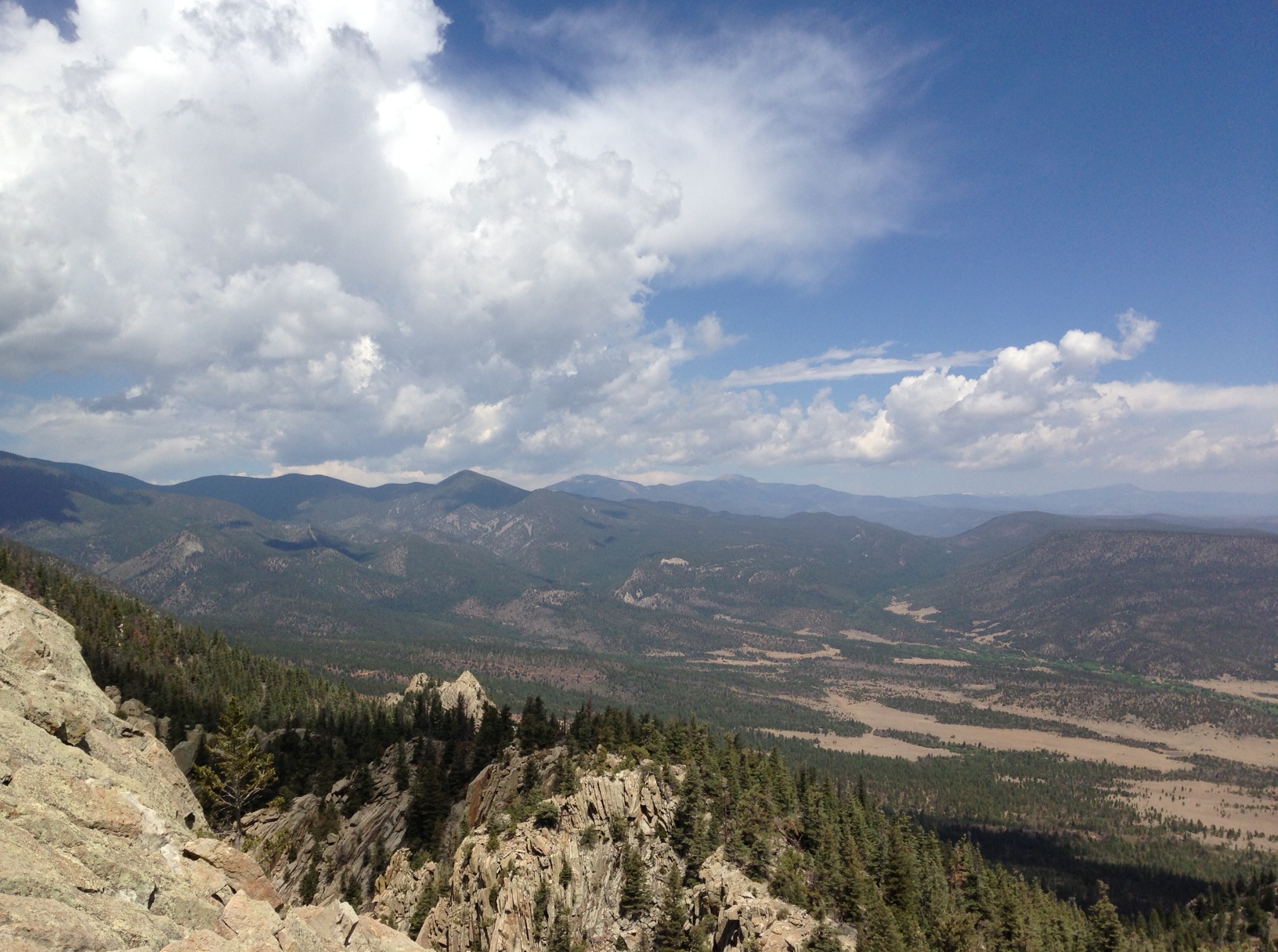
The attached photo is from the top of the Tooth of Time, a day hike that our department took together to celebrate the end of our training. 

While I know that this is not Southern California, that I’m here where the dust blowing can cover the sun, I am out here reporting and writing articles while hiking in the wilderness weekly or bi-weekly. How more does writing and camping cross?

Until next time,

Joe

Southern Europe!

Hey all!

I know it’s been a while since I posted, the second half of second semester got crazy and school work had to come first. But now I’m back, and I just posted my stuff about my Europe trip from the last month. Right now I have my final evaluation of the trip up, as well as the daily field entries. To come in the fall will be photos from the trip as well as my daily video entries. Look at it! Enjoy it!

Until next time,

Joe

Wilderness First Responder (WFR: Woofer)

I just finished an intense 7 day course yesterday, which earns you the Wilderness First Responder certification in wilderness medicine. (Offered by the Wilderness Medical Associates).

Each day is about 10-11 hours long, which does not include the homework (typically reading and some examination of case studies). In that time you spend many hours in the classroom taking notes on whatever it is you’re learning whether it be critical systems (circulatory, respiratory and nervous) and their potential respective problems (no pulse, not breathing or no consciousness) or some other illness/problem such as hypothermia or anaphylaxis.

When you’re not in the classroom taking notes, you’re outside either learning hands on treatments (such as CPR) doing patient assessment drills or taking part in simulations. The patient assessment drills typically worked so that there were two “WFRs” to one patient and the “WFRs” were given the basic location and activity, and they had to figure out what potential and actual problems there were, and what the best plan or treatments are.

So what are the simulations? The simulations are very similar, only instead of each person being an individual patient, most of them are scenes with multiple casualties. Perhaps a better phrase is a scene of mass chaos. The rest of the class serves as a rescue team that must work together to secure the whole scene. I won’t reveal what our specific simulations are, so that others looking at getting the certification can still be surprised, but it was intense. The teacher video records much of it, and afterwards, plays the video so he or she can go over what went well and what didn’t go so well. Also the thing with the simulations is, be prepared for very realistic looking wounds. Especially if the instructor has had good training, the make-up jobs are really realistic, all the way down to vomit which is a mixture of oatmeal, parmesan cheese and orange juice. Truly disgusting. But if you are squeamish, be prepared for some very real looking lacerations to the head and etc.

It was intense: emotionally, mentally and physically stressful and draining, but there’s a lot to be learned. And the confidence that comes after passing is tremendous. It is well worth the time and stress for anyone looking to be serious outdoors people.

Until next time,

Joe

Geocaching the University of Redlands

Image

Last week Friday, a group of friends and I went geocaching around the University of Redlands campus. Now I’ve never been a person huge on geocaching. My experience to that point had largely been in the context of scout campouts and all you do is find the coordinate and woohoo, let’s find the next one.

In this case, there was a coordinate given that we had to find, and then a hint (typically related to the area and some riddle that revealed the specific location in the answer). The really cool part about it was that within each object, there was a roll of paper that people signed whenever they had found the geocache. Some of them went as old as 2007. Adding our names to a legacy even as minor as that was really quite cool. Who knows, maybe 10 years from now someone will find it again and see our names on there.

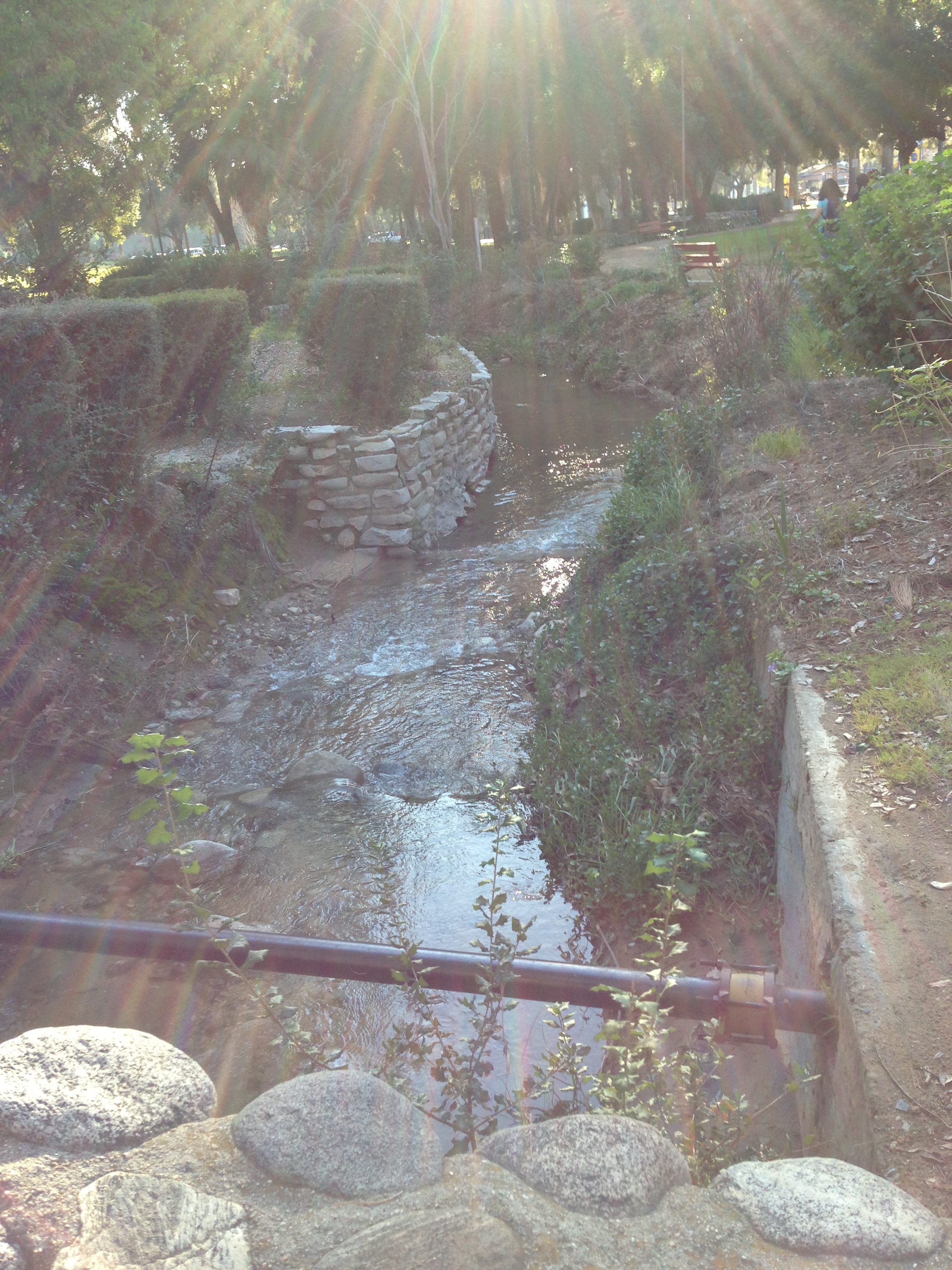
The above photo is near one of the geocaches, in a park right across the street from the university. The afternoon was beautiful and this shot is from a bridge stretching over the creek running through the park. Who knows, maybe we’ll go geocaching again some day.

Snow on the Mountains!

Snow on the Mountains!

Hey there!
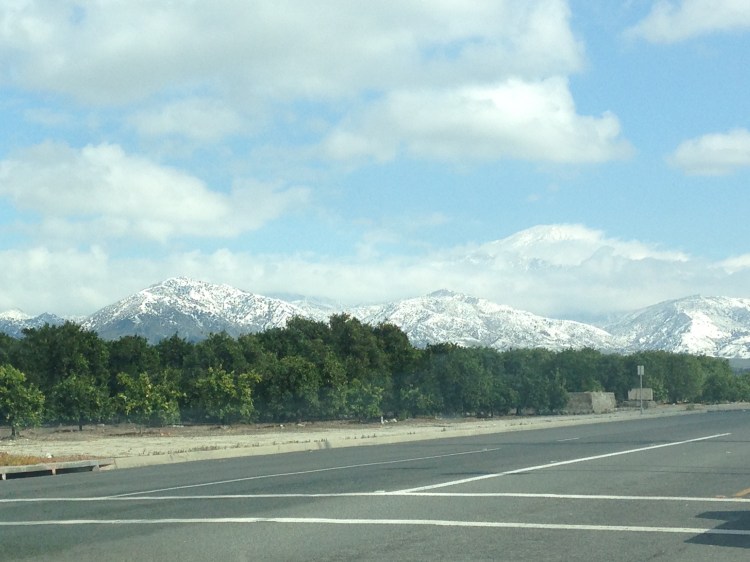
So we finally had snow on the mountains after about a 24 hour period of cold rain. The day following that rain (yesterday) a group of friends and I spontaneously decided to go play in the snow. It was quite amazing, snowball fights and snowmen and snow angels. It was quite reminiscent of my childhood (a chicagoan to the heart). It was also nice to be able to get off campus, because with a lack of OP trips (being a trip leader instead of participant now) getting off campus, other than the occasional trip to Target, hasn’t been very easy. This photo is just one of many from our trip, and is a particularly awesome shot of the mountain range capped in snow.

Until next time,

Joe